Deep pockets, measured
A fitted sheet pops off at 2 a.m. for one arithmetical reason. Stand a tape at the mattress corner and the right pocket picks itself.
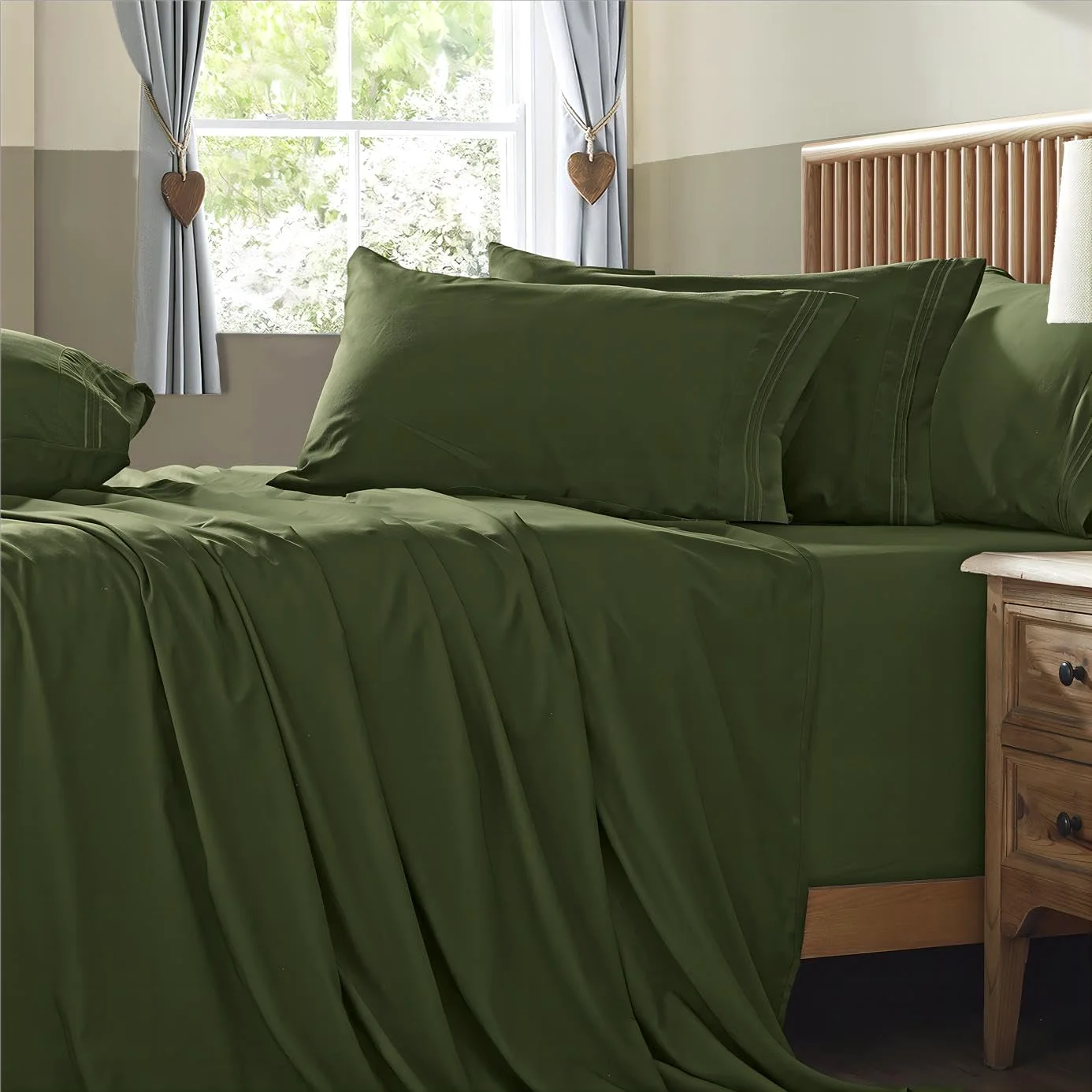
You know the move. It is 2 a.m., you turn, and your fitted sheet surrenders a corner. The elastic snaps up the side, the mattress shows, and sleep is over until you wrestle it back. By morning you are ready to buy another sheet that almost fits. Almost is the word that does the damage. A fitted sheet is geometry. Width and length matter, but height is the number that decides if you sleep through the night. Measure it, match it, and the corner stays put.
Your bed has three numbers: width, length, height
You probably know the footprint of your mattress. In the United States, the standard widths and lengths are fixed. Here are the common sizes.
| Size | Footprint (inches) |
|---|---|
| Twin | 38 x 75 |
| Twin XL | 38 x 80 |
| Full | 54 x 75 |
| Queen | 60 x 80 |
| King | 76 x 80 |
| California King | 72 x 84 |
A Twin XL is five inches longer than a Twin. College dorms are almost always Twin XL. If you shop for a Twin for a dorm bed, the sheet will come up short. So you check the footprint first, and you get the right base size.
Then you handle the neglected third number. Height. Mattresses today tend to be taller than they were a decade ago. Many run about 10 to 16 inches tall. If you sleep on a topper, count that too. A topper can add 2 to 4 inches to the stacked height, and a nice plush corner is the exact place a shallow pocket loses its grip at night.
You measure height at the corner, not in the middle of the side panel where quilting and piping can confuse your eye. Stand a tape measure upright at the corner. Put the end on the foundation and read seam to seam. If your topper lives on the bed, keep it on for the reading. You want the real working height. You can do it alone in a minute. Pull back the fitted sheet and the mattress protector if you need a clean view of the seam. Stand the tape, steady it with a finger, and read the true number.
How to measure once, buy once
You save yourself work when you decide to measure like a habit. Here is a simple path that gives you the right pocket depth on the first try.
- Strip just the fitted sheet. Leave your topper and protector on the mattress.
- Find the corner with the cleanest view of the upper and lower seams.
- Stand your tape on the base and pull it straight up to the top seam. Read the number to the closest quarter inch.
- Check the opposite corner the same way in case your foundation or floor is not perfectly level.
- Write the number down.
Now you translate that height into the pocket depth you need. A fitted sheet pocket should exceed your measured mattress height by about an inch. That spare inch tucks under the bottom edge and lets the elastic sit on the underside of the mattress, not on the side panel. A pocket that is shallower than the mattress rides on tension alone and pops at night.
If you measured 12 inches in height, you aim for a 13 inch pocket. If you measured 15 inches, you aim for a 16 inch pocket. If you measured 16 inches with a topper, you will want a 17 inch pocket or a labeled deep pocket sheet that covers that height. The math stays the same. You add about one inch.
Two quick examples:
- Your queen mattress measures 11 inches without a topper, and you add a 2 inch topper in winter. That gives you 13 inches in the colder months and 11 inches in the warmer months. A 12 inch pocket will likely ride on tension in winter. A 14 inch pocket gives you the spare inch year round.
- Your king measures 14 inches and you use a quilted protector that adds about half an inch. Round that stack to 14.5. Add the spare inch. A 16 inch pocket is a good target.
You will see the phrase deep pocket in product names. Treat it as a flag to read the actual number, not a guarantee of fit. Deep pocket can mean 15 inches on one card and 18 inches on another. Your number decides. When the pocket matches your measured height plus the spare inch, the elastic sets under the base. That is the grip you feel when a corner stays down during a turn.
Pocket depth and the spare inch
Pocket depth is not a guess. It is the stitched height of the fitted sheet from the top seam to the elastic edge. If the mattress is the third number you measure, pocket depth is the third number you select.
That spare inch is not a cushion for error. It is what gives the elastic a place to land under the mattress. Think of the fitted sheet as a cap that must wrap the lower edge and bite the underside. If the pocket ends level with the side of your mattress, the elastic has nowhere to sit but on the vertical face. The band stretches to hold, you move, it lifts, and the corner works its way up.
Add the inch and the elastic sits under the bottom seam like a belt around the waist rather than a ribbon hanging on the hip. It resists upward pull. It rebounds after a turn. It forgives a slightly uneven tuck. That is why you do not match pocket to height one to one. You give yourself the inch.
A pocket that is shallower than the mattress is almost certain to ride on tension. That is the 2 a.m. scenario. The sheet is working against height and friction alone. Even a new elastic band will fatigue if it lives on the side panel under constant strain. The corner will slip first because it has two edges to climb instead of one.
You can check pocket depth at home if you are sorting older sets. Set a fitted sheet on a flat table. Measure from the inside of the top seam to the inside of the elastic edge. That is the pocket. If it reads 14 inches and your mattress with topper reads 15 inches, you know why that set gives you trouble. If it reads 16 inches and your mattress reads 12, you know you are likely in safe territory once the elastic can wrap the underside.
Elastic that holds: all around beats corners
Not all fitted sheets grip the same. Elastic construction is the other quiet detail that controls how a corner behaves under load. You will meet two basic builds. One has elastic only at the corners. The other has elastic all the way around the pocket.
Elastic all round the pocket grips better than corner-only elastic. A continuous band spreads tension evenly around all four sides. When you turn or sit on the edge, the load shifts into the band as a circle, not into four small triangles at the corners. That means less local strain. It also means the band has a better chance to climb back under the mattress after you release pressure.
Corner-only elastic can work on a low stack with a snug pocket, but it gives you less range. If you like a tall pillow-top or a topper, you feel the difference in a week of use. The corner triangles must stretch hard to reach under. They fatigue faster under high heat and frequent tumbles. You can still get a good night’s sleep with corner-only elastic on a modest height. If you are fighting a popped corner, the detail is worth checking.
When you unpack a set, run your fingers around the edge. You can feel a continuous band in the hem by the even tension as you stretch and release. If you feel it only in the corner arcs, you know the type you have. Neither build turns a wrong pocket depth into a right one. A good band is a helper, not a substitute for a matched number.
Homiest pocket depths and what comes in the set
You do not need a dozen numbers in your head when you stand in front of a shelf of packaging. You need one measured height and a short map of the fits on offer. Here are the pocket depths you will find in Homiest fitted sheets and sets.
- Satin fitted sheets have 15 inch pockets. Your mattress stack should measure about 14 inches to tuck under with the spare inch.
- Bamboo rayon sets have 16 inch pockets. You are covered for stacks around 15 inches.
- One king set is cut for 18 to 24 inch mattresses. It is a six piece set in brushed microfiber. The ticket price is $31.99. If your king measures 17 inches you will appreciate the range. If it measures 20 inches, you will be relieved to find a pocket that can wrap and seat the elastic under the base.
Use your measurement to choose. If you have a queen that measures 10 inches and no topper, a 15 inch pocket will still tuck under with room. If you have a full that measures 15 inches after you add a 3 inch topper, a 16 inch pocket is a cleaner match. If you have a very tall king, the deep range set is the one designed to handle that job.
Set contents differ, and the card counts them exactly. A bamboo twin set is 3 pieces. You get a fitted sheet, a flat sheet, and one pillowcase. Full and queen bamboo sets are 4 pieces. You get a fitted sheet, a flat sheet, and two pillowcases. Ruffle sets pair a fitted sheet with ruffled pillowcases, and include no flat sheet. A twin ruffle set includes one ruffled pillowcase. Larger sizes include two. If you sleep cold and rely on a flat sheet, check for it on the card. If you prefer the look of a ruffle and layer with a duvet, the ruffle set gives you the pieces you plan to use.
The card lists pocket depth too. Read it for the number, not just the phrase deep pocket. If you see 15 inches and you measured 14, you are on plan. If you see 15 inches and you measured 16, that is a near miss you will feel by the second night. The corner will rest on the side under tension. You may be able to make it work by pulling hard and trapping the band under a heavy mattress, but that is a nightly chore. The measured number rescues you from that bargain.
If you change beds in the house seasonally, match pocket to each mattress rather than buying a single deep set to float between rooms. A pocket that is much deeper than the mattress can still tuck, but you can feel slack in the side panel if the difference grows. You will get a better fit and a neater look when the spare inch is close to an inch, not a handful.
Toppers and protectors: include them in the number
Many fit problems trace back to a topper that was not included in the first measurement. You add a foam layer for pressure relief or a plush down alternative pad for warmth. The bed feels right, then the sheet feels wrong. The corner creeps up because the fabric geometry shifted after you chose the pocket.
You fix this by measuring the bed you actually sleep on. If the topper lives on the bed ten months of the year, include it. The common range for toppers is 2 to 4 inches. A 12 inch mattress plus a 3 inch topper reads like a 15 inch stack at the corner. You add the spare inch. You shop a 16 inch pocket. If you pull the topper in July and August, write both heights on a card. When the seasons change, pull the fitted sheet that matches the stack you are using.
Protectors add height too. Some are lean. Some are quilted and thick. If you add a protector after you measured the bare mattress, measure again with the protector installed. If you share a bed with a child or a pet and wash the protector often, this recheck is a smart habit. The protector’s fill can flatten a little with time. Your real height can drift a half inch down over a year. Measure twice and you buy right twice.
If you ever have to choose between what a general guide says and what a sewn-in care label on your product tells you to do, the label wins. That applies to washing directions and to fit notes. The label is written for the exact fabric, elastic, and stitch used in that set. Respect it.
Care that preserves the grip
Elastic is a living material in the way that matters to you. It relaxes with heat and strain. If you ask your fitted sheet to hold a corner by tension alone, the band will stretch and stay a little longer each week. You can slow that change with care choices.
High dryer heat relaxes elastic over time. Low heat keeps the grip longer. If you have a setting for low or air dry, use it. If you can dry to damp and finish on the bed, that can help the fabric relax into the mattress shape. You do not need to iron. You do want to avoid baking the band. Even if you are in a rush, medium beats high.
Washing frequency matters too. You can wash sheets weekly and keep them fresh. If you do, the dryer setting matters more. If you wash monthly, elastic will still age, just more slowly. If you add a heavy blanket or towels to the dryer with your fitted sheet, the load can wrap and twist. That can put torque on the band. Try to dry sheets with other light items. Give the elastic space to move without strain.
If a label asks for a specific temperature or setting, follow it. The label wins. The maker wrote it for the exact elastic used. You get longer life and a more predictable fit when you honor the stitch.
When you store sets, fold the fitted sheet with the elastic inside to reduce snagging. Slip the whole set into one pillowcase so you do not hunt for partners on laundry day. None of that changes the pocket depth, but it keeps the parts together. That means the right pocket meets the right bed when you reach for it.
A checklist before you choose the next sheet
You can save yourself from another almost-fit with a short check. You worked to measure, so use the number. Treat this like pinning a seam before you sew. Simple, neat, and worth it.
- Confirm the mattress footprint. Twin 38 x 75 inches. Twin XL 38 x 80. Full 54 x 75. Queen 60 x 80. King 76 x 80. California King 72 x 84. For dorms, pick Twin XL.
- Measure height at the corner seam to seam, with your topper and protector on if they live on the bed. Most mattresses run about 10 to 16 inches. Toppers add 2 to 4.
- Add about one inch to your measured height. That is your target pocket depth. A pocket shallower than your mattress rides on tension alone and pops at night.
- Run your fingers round the hem: a continuous band beats corner-only arcs.
- Read the set contents on the card. Bamboo twin sets are 3 pieces. Full and queen bamboo sets are 4. Ruffle sets pair a fitted sheet with one or two ruffled pillowcases and include no flat sheet. Choose the contents you will use.
- Match your number to Homiest pocket options. Satin fitted sheets: 15 inch pockets. Bamboo rayon sets: 16 inch pockets. One king set: 18 to 24 inch range, six pieces, brushed microfiber, $31.99. Choose the one that covers your height plus the spare inch.
- Plan laundry care. Lower dryer heat preserves elastic longer. If the sewn-in label gives a different direction, the label wins.
You feel the difference the first week you sleep on a pocket that matches your bed. You tuck the corners once. You turn at 2 a.m. and do not wake up. The fabric stays wrapped under the base, not stretched thin across the side. You made a small measurement and a small choice, and the night got quiet. That is the promise of a number.
Your room can be as simple or as layered as you like. Ruffles or no ruffles. Bamboo rayon or satin. White or color. Those are taste calls. Fit is not a taste call. It is a small habit that pays out every night. You measure the third number. You add the inch. You read the card. You pick the set that matches the bed you actually sleep on. Then you go to bed and stay there.
One button, the whole range
Every colour, size and piece count in the Homiest lineup is one press away. Your measurements travel with you: the size sits in the name of every piece.